Paramedic
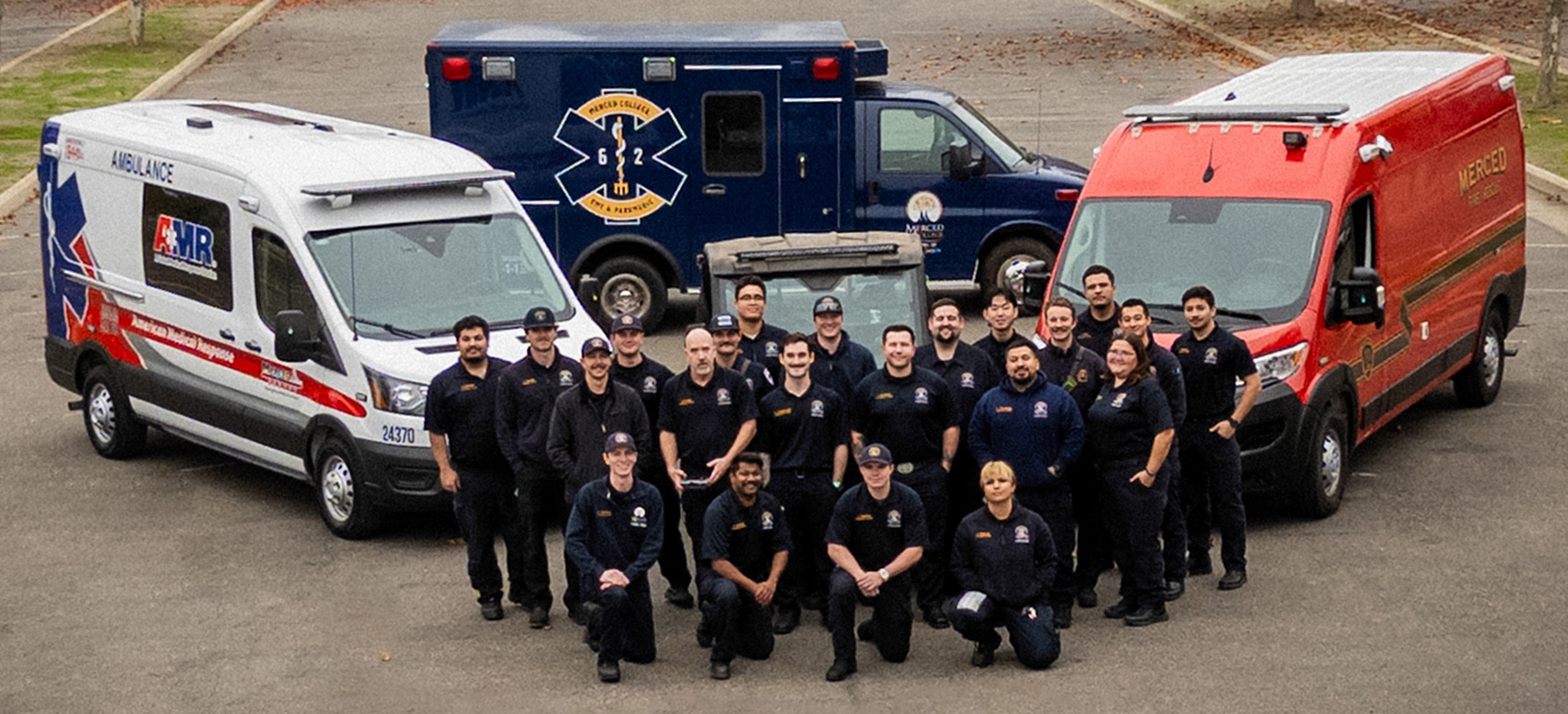
Program’s Minimum Expectations (CAAHEP Standard II.C.)
“To prepare Paramedics who are competent in the cognitive (knowledge), psychomotor (skills), and affective (behavior) learning domains to enter the profession.”
Paramedic Program
The Cohort 5 application period is open 7/1/2026 and close on 8/31/2026.
Qualified applicants will be invited to test on 9/9/2026 or 9/16/2026 at 1000 in person in Merced, CA.
Cohort 5 will commence on 1/12/2027.
Program Description
Paramedicine is an allied health profession whose specialty is to provide pre-hospital emergency medical care at the Advanced Life Support (ALS) level. Didactic, clinical, and field internships prepare the student to assess and treat a wide variety of medical and traumatic emergencies in the pre-hospital setting. The knowledge and skills acquired through the program will prepare students to meet the professional responsibilities outlined in the Paramedic scope of practice per the California Code of Regulations, Title 22, and to meet certification standards for Paramedics as outlined by the National Registry of Emergency Medical Technicians (NREMT). Credit Value: 39 units (includes field and clinical experience)
Paramedic Pathways
Degrees/Certificates
Merced College offers the following degrees/certificates in Paramedic:
Paramedic (CE)
Career Opportunities
This certificate leads to potential employment with ambulance providers, fire departments, police departments, hospitals, doctor’s offices and private companies who require on-site emergency medical responders. Many who enter at the Paramedic level also choose to continue their education toward an advanced health care profession.
Certifying Exam
Completion of courses EMER-10, EMER-11, EMER-20, EMER-21, EMER-30 and EMER-31 meet the requirements of Title 22, Division 9, Chapter 2 of California Administrative Code. Students successfully completing the courses are eligible to take the Paramedic certifying exam from the National Registry of EMT.
Limitations on Enrollment
Limitations on enrollment for EMER-10, EMER-11, EMER-20, EMER-21, EMER-30, AND EMER-31: Participants must have taken EMT course within the last collegiate calender year, passed with grad of B or better, and successfully pass entrance examination. OR, if NREMT 1 Certification held for greater than one (1) year-proof of field experience and successful completion of entrance examination. NREMT 1 Certification ( current), and maintained throughout coursework. Minimum 18 years of age, Live scan background clearance. Health screen clearance. BLS Health care Provider card (current) and maintained throughout the course. Based upon State and Federal Regulations, CA Title 22.
Course Descriptions: EMER-10, EMER-11, EMER-20, EMER-21, EMER-30 and EMER-31
- See the course catalog for full details on enrolling in these courses, other EMT courses, pre-requisites and limitations.
Accreditation Status:
The Merced College Paramedic program holds a Letter of Review, which is NOT a CAAHEP accreditation status, but is a status granted by the Committee on Accreditation of Educational Programs for the Emergency Medical Services Professions (CoAEMSP) signifying that a program seeking initial accreditation has demonstrated sufficient compliance with the accreditation standards through the Letter of Review Self Study Report (LSSR) and other documentation. However, it is NOT a guarantee of eventual accreditation.
You can contact the Committee on Accreditation for the EMS Professions (CoAEMSP) by:
Phone: (214) 703-8445
Fax: (214) 703-8992
Address: 8301 Lakeview Parkway, Suite 111-312, Rowlett, TX 75088
Website: www.coaemsp.org
Program Results
National Registry of EMTs Written and Practical Examination passing rate (cumulative passing rate of graduates on the NREMT written exam within 3 attempts): students are in progress and not yet eligible to take the NREMT paramedic examination.
Retention Rate (percentage of students graduating from the program): 31 of 35 students initially enrolled are still in progress and are not yet eligible for graduation.
Positive Placement (percentage of students who are employed full or part-time in a related field and/or continuing his/her education and/or serving in the military): students are still in progress and not yet eligible for employment as a paramedic.
*last updated 6/17/2026
National Registry of EMTs Written and Practical Examination passing rate (cumulative passing rate of graduates on the NREMT written exam within 3 attempts): 94.44%
Retention Rate (percentage of students graduating from the program): 18 of the 30 students initially enrolled have graduated; 3 are still in progress.
Positive Placement (percentage of students who are employed full or part-time in a related field and/or continuing his/her education and/or serving in the military): students are in progress.
*last updated 6/17/2026
National Registry of EMTs Written and Practical Examination passing rate (cumulative passing rate of graduates on the NREMT written exam within 3 attempts): 95.24%
Retention Rate (percentage of students graduating from the program): 77.78%
Positive Placement (percentage of students who are employed full or part-time in a related field and/or continuing his/her education and/or serving in the military): 100%
*last updated 6/17/2026
National Registry of EMTs Written and Practical Examination passing rate (cumulative passing rate of graduates on the NREMT written exam within 3 attempts): 96.15%
Retention Rate (percentage of students graduating from the program): 89.66%
Positive Placement (percentage of students who are employed full or part-time in a related field and/or continuing his/her education and/or serving in the military): 96.15%
*last updated 6/17/2026
Paramedic Faculty
-
Steven L Melander
ProfessorEmergency Medical HoursOffice Hours: Tuesday: 8:30a-9:30aOffice Hours: Thursday: 8:30a-9:30pOffice Hours: Friday: 9:00a-10:00a
 -
Kimberly A Parker
ProfessorEmergency Medical HoursOffice Hours: Friday: 9:00a-10:00a