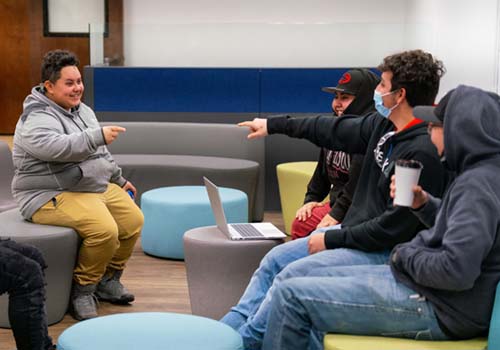
Merced College has for years offered programs to specifically reach and nurture Black students, Latino students, disabled students, students who are military veterans, foster youth, homeless or anyone struggling academically.
Now the college’s new Equity Center is a home for all of them. It is a destination where students can find help for anything that might make it harder to chase an education.
It’s the hub.
“We’ve been open for a semester,” said Joe Serena, the college’s Dean of Student Equity and Success. “We’re waiting for some furniture and signage before we do a grand opening. But we want to be running at full speed as soon as possible, because our students need this help.”
Educational equity means each student receives what they need to reach their academic and social potential. Students could need a laptop, bus fare, help paying rent, money for food, help registering for CalFresh or Medi-Cal, or a welcoming smile and someone to chat with.
“You need to be a jack of all trades to work at the Equity Center,” Serena said. “You need to know every available resource on campus. … I want the equity center to be an additional level of support beyond the [academic guidance] they get. It’s ‘Let’s talk about your future. I’m here for you.’”
Now located in the student union, the Equity Center is the remodeled former home of the college’s tutoring operation, which was relocated to the Lesher Building. Both moves have centralized important student services.
The hub will soon be fully staffed with a student services worker, three student workers, three equity counselors and a peer mentor.
“The center is the umbrella organization for our special programs,” said equity counselor La Hang, who is new to Merced for 2021-22. “The goal is for us to be the point of contact for students from the moment they arrive.”
When all students return
Encouraging Merced College students to use the Equity Center is important right now. EdSource reported in November that enrollment across the state’s 116 community colleges had decreased 14.8% and dropped below 2 million for the first time in three decades since the pandemic forced campus closures in March 2020.
The California Budget and Policy Center reported in October that the biggest drops in school enrollment overall were among students of color and students with low incomes aged 19 to 24. Students reduced their course loads or simply dropped out.
No one at Merced College is waiting for students to return. They’re doing “intrusive counseling” — calling, emailing, using Canvas, the school’s education platform, and instant chat on Pronto, a communication app, and walking straight up to students.
“Joe is allowing us to be creative in how we reach out,” Hang said. “The more contact we have with them the better.”
California Gov. Gavin Newsom’s latest budget includes $150 million for community colleges to address issues like retention, housing, food insecurity, health, access to technology, child care, completing transfer requirements and career training.
“The Equity Center will offer so much more, like workshops on different cultures, guest speakers, and other events,” said NextUp Foster Youth program coordinator Dondi Lawrence.
“The center serves a larger, diverse population of students. So this place, it’s your home base. If not for this center, I’m not sure where some students could go to feel comfortable. [The Equity Center] feels right.”
Equity counselors have been able to work smarter to find LGBTQ and undocumented youth who might be feeling too isolated to thrive in college.
Staffers had reached out to first-year student Keith Parker last fall. When Parker, who is transgender, showed up days later, they immediately asked which pronouns she uses. (Parker uses she/her.)
“They made me feel safe and accepted right away,” Parker said. “Other people on campus, you have to go to their offices. But [people at the Equity Center] find you and ask, ‘Hey, do you need help? Come to the Equity Center.’”
Parker would tell any new Merced College students to just show up.
“The center is a place for me to wrap my head around being in college and to take a break,” she said. “It’s a place I can be myself and not feel like someone is staring at me.”
Students hear about the space and drop by. The center’s twin 80-inch flatscreen TVs welcome people in, while the foosball, air hockey and ping pong tables do a brisk business.
It’s not just entertainment. It sets the tone.
“It’s a one-stop shop,” Hang said. “A student walks in the door and we don’t know what they need; every student is unique. But we do know we can help in some way.”